
The moment you’re told you’re high risk for breast cancer, something shifts.
Your body goes on high alert.
Your nervous system flips into survival mode.
And suddenly, everything feels different — even when nothing has technically changed.
You listen more closely to your body.
You scan for signs.
You second-guess decisions that used to feel simple.
You’re not imagining it.
This is what happens when your brain is told there’s a threat.
High risk doesn’t just change how doctors look at you.
It changes how you feel.
Every scan feels loaded.
Every ache feels suspicious.
And in the background of your life, there’s a constant hum of being on high alert.
Most women in this position are told the same thing:
“Let’s just watch and wait.”
But when you’re already in survival mode, waiting isn’t neutral.
Waiting keeps your nervous system on edge.
Waiting robs you of a sense of control.
Waiting makes cancer feel inevitable — like something you’re just waiting to be sentenced to.
That is not harmless.
And it is certainly not prevention.
The problem no one talks about
High-risk women are left in an impossible position.
You’re told to be vigilant — but not proactive.
To monitor — but not intervene.
To wait — while carrying the emotional weight of when, not if.
Over time, that messaging does real damage.
It makes you feel powerless.
It makes cancer feel inevitable.
And it leaves you stuck between options you don’t want.
Watch and wait. Toxic drugs you don’t want.
Or major, life-altering surgeries that permanently change your body.
Most women don’t like these options. They just don’t know there is another choice.
And so they live in limbo — not sick yet, but certainly not feeling healthy.
Conventional repeated surveillance is not benign.
It keeps women in a constant state of alarm.
It reinforces the belief that a diagnosis is inevitable.
And it often relies on repeated imaging that adds physical and emotional burden without actually reducing risk.
What if prevention took away the fear?
What if prevention felt calm?
Intentional?
Steady?
What if you knew — with confidence — that you were supporting your body in ways that actually mattered?
Not perfectly.
Not obsessively.
But consistently.
That’s what real prevention looks like.
Introducing the Breast Cancer Prevention Program
The Breast Cancer Prevention Program is a foundational experience for high-risk women who want to take control of their breast health before disease develops — without panic, overwhelm, or living in constant alert mode.
This program helps you move from:
• Constant monitoring → intentional action
• Fear-based decisions → calm confidence
• Waiting and worrying → living fully
Prevention isn’t about doing everything.
It’s about doing the right things — in the right way — over time.
Here’s how your going to take control of your breast health and reduce your risk, starting today.
Here’s what you get:
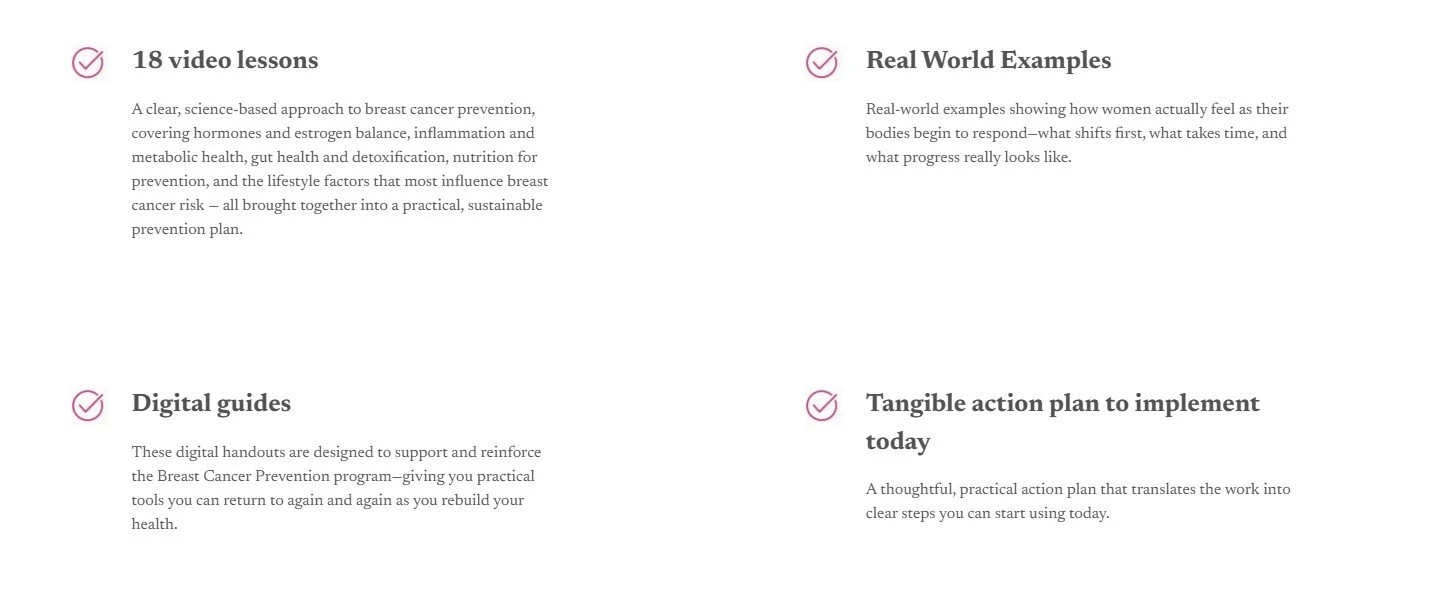
Instant, Lifetime access!
After being told I was high risk, I felt like I was just waiting for something bad to happen. I joined the Breast Cancer Prevention Program because I wanted to do something. Earlier this year my Auria Tears Test was clinically significant. After going through the prevention program, my most recent results came back negative. I am so thankful and grateful for this course — it has been truly life‑changing for me
This program is for you if
You’ve been told you’re high risk for breast cancer because of:
A genetic mutation
A strong family history
Atypia on a breast biopsy
Extremely dense breasts
A clinically positive Auria Tears Test
And you want:
To feel proactive instead of powerless
To stop living in “watch and wait” mode
To trust your body again
To reduce risk without turning your life upside down